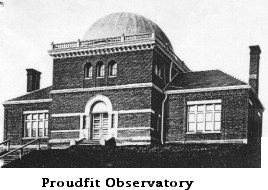
The Proudfit Observatory
Imagine yourself in the late 1800's. Newtonian physics reigned (along with Queen Victoria) and was yet to face the challenges of quantum physics. God was still the master clock maker and this was one of the golden ages of Astronomy. The US Naval Observatory was established in 1844; the Greenwich Observatory completed its new 28" refractor in 1893. Using new knowledge from physics and chemistry, people sought to understand the rules and ordering of the universe.
At the same time terrestrial technology was expanding rapidly. Edison was busy inventing the Phonograph and the Light Bulb (1877-79). Cast and wrought iron emerge as major structural materials (the Crystal Palace in England was built in 1851, and cast iron facade buildings abound in NY City in the 1870's and 80's).
Lightweight construction materials were yet impractical. Aluminum was expensive, still awaiting the invention of the Hall process in 1886 to turn it into a commodity item. In this environment the thought of applying the same paper and wood-frame technology, that was used in boat building, to observatory domes was probably a lot more appealing than it might seem today. Thus in 1878, the first of a series of paper observatory domes was built by E. Waters & Sons, (the 19th century paper boat manufacturers in Troy NY.) It was for a local observatory donated to the Rensselar Polytechnic Institute in Troy by the Proudfit family Professor Greene, of RPI, provides the following rationale for paper construction:
"I ascertained that a dome of the dimensions required, constructed in any of the methods in common use, would weigh five to ten tons, and require the aid of cumbersome machinery to move it. It therefore occurred to me to obviate this objection by making the frame-work of wood, of the greatest lightness consistent with the requisite strength, and covering it with paper of a quality similar to that used in the manufacture of paper boats; the principal advantages in the use of these materials being that they admit of great perfection of form and finish, and give extreme lightness, strength, and stiffness in the structure . . ."
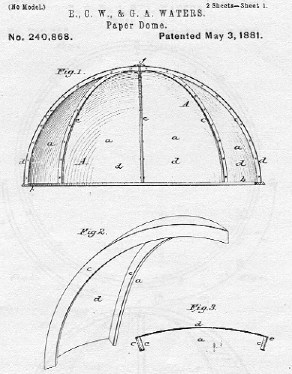
While the Waters were initially, (and exclusively,) known for boat manufacture, their minds apparently remained at work on other projects and other opportunities. In 1878, they built a paper observatory dome for the newly erected Proudfit Observatory at Rensselaer Polytechnic Institute in Troy. The construction method was almost identical to that used for paper canoes; thick linen paper was formed over a mold of a dome segment that already contained a wooden framework which was removed from the mold with the paper. Finished sections were bolted together and the joints were weatherproofed with cotton cloth saturated with white lead. The RPI dome was 29 feet in diameter and consisted of 16 sections plus a 4-foot wide shuttered opening for the telescope. It weighed 4000 pounds of which paper alone accounted for approximately 1000 pounds. The dome was supported by six eight-inch balls, which moved between grooved iron tracks and could, "be easily revolved by a moderate pressure applied directly without the aid of machinery." The dome lasted for over twenty years and was removed, not because of decay, but to convert the building to other uses in 1889
http://home.eznet.net/~kcupery/dome.html